
Kyle Elite Concrete pours stamped concrete in Kyle, TX and has spent more than 20 years doing it, serving surrounding cities including Buda, San Marcos, Manchaca, Shady Hollow, Redwood. Stamped work is ordinary structural concrete with a texture and a color system applied during a window that closes fast, which is why the crew matters more here than on any other flatwork.
The appeal is straightforward. You get the texture of stone, slate, brick or plank across a monolithic slab with no individual units to settle, shift or grow weeds between, at a cost well under the equivalent in real material. Done properly it reads as the material it imitates from a normal viewing distance.
Done badly it reads as stamped concrete from across the street, and the usual reasons are a pattern with too little relief, color applied without depth, or joints cut through the middle of the design as an afterthought. Those are all decisions made before the pour, which is where we spend the time.
How Stamped Concrete Is Actually Made
Placing, Coloring and Stamping in One Window
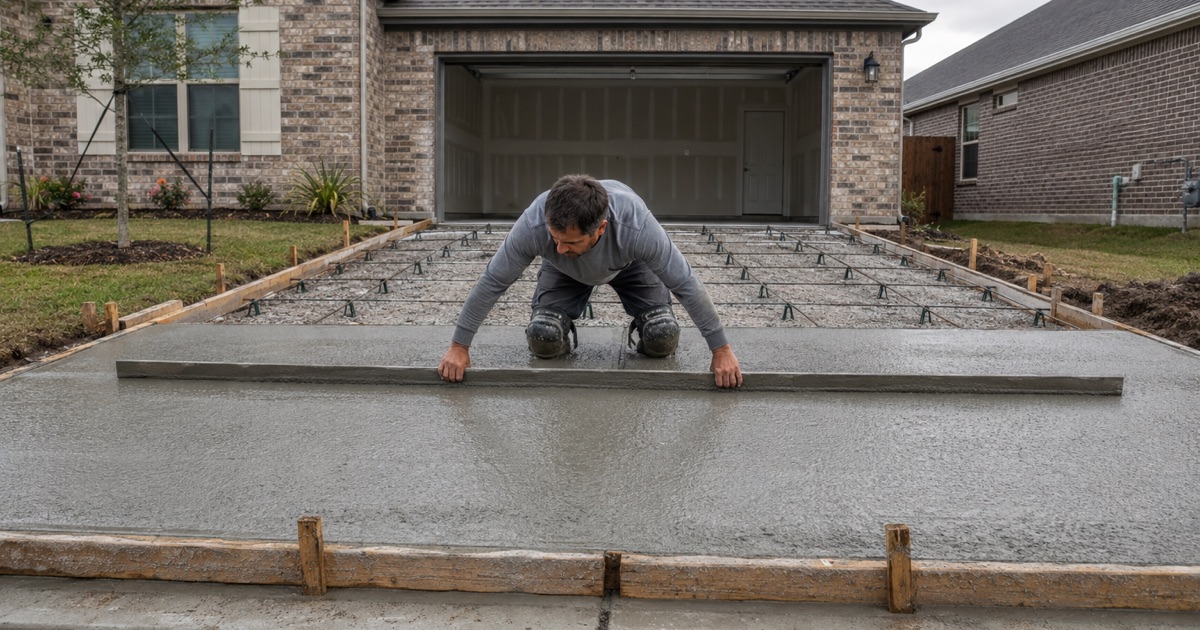
The slab is placed and floated like any other, and then everything decorative happens while the concrete is still plastic enough to take an impression and firm enough to hold one. That window is short, and in Kyle heat it is shorter. We crew a stamped pour heavier than a plain one specifically so the whole field gets stamped inside it rather than the last section going in stiff.
Release Agent and the Second Color
A release agent keeps the stamp mats from sticking, and a colored release does a second job at the same time: it settles into the low points of the texture and leaves a secondary tone that gives the surface variation real stone has and flat color does not. How much is washed off afterward sets how strong that contrast reads. We agree the look on a sample before it goes on your slab.
Sawcut Joints Through a Stamped Pattern
Concrete needs control joints whatever is printed on it, and the difference between a good stamped job and a poor one is often just whether the joint layout was designed alongside the pattern or added later. Joints hidden in a grout line or a border read as part of the design. A joint sawn straight across a field of imitation flagstone reads as damage.
Patterns and Color That Age Well
Stone, Slate, Wood Plank and Ashlar Patterns
Ashlar and running bond stone patterns are the workhorses because their geometry is regular enough to lay out cleanly around a real space. Slate textures give depth without a strong repeat. Wood plank stamps have become popular and look best where the run is long enough to avoid an obvious repeat. We show you the mats and the repeat length rather than a catalog photograph.
Integral Color, Color Hardener and Antiquing
Integral color is mixed through the batch so the color goes all the way down and cannot wear off, which makes it the safer base on anything that takes traffic. Color hardener is broadcast onto the surface and worked in, producing a denser, harder and brighter top layer. Antiquing with a colored release or a stain on top adds the tonal variation. Most jobs we do use two of the three together.
Borders, Bands and Field Layout
A large stamped area benefits from a border in a contrasting pattern or a plain band, which frames the field, gives the joint layout somewhere natural to run, and stops the eye from finding the repeat. Bands also let a big pour be broken into panels that make sense. It costs little at the layout stage and changes how the finished surface reads.
Where Stamped Concrete Belongs
Patios and Outdoor Living Areas
Patios are where most stamped work goes, and the design questions are how the surface meets the house, where the isolation joint runs, and whether the color will still be liveable in ten years. Strong colors date faster than muted ones. We detail the isolation joint at the structure so the patio can move without pushing on the foundation.
Pool Decks and Bare Feet
Around a pool the surface has to be grippy when wet and tolerable underfoot in July, which pushes toward lighter colors and a texture with genuine relief rather than a smooth imitation of polished stone. Sealer choice matters here too, since a heavy gloss film gets slick. We choose the pattern for traction first and appearance second.
Driveways, Walks and Entries
Stamped work on a driveway has to satisfy the same city requirements as any other drive, including thickness, reinforcing and the joints Kyle specifies, so the decorative layer sits on top of a fully compliant slab rather than replacing any part of it. Entries and front walks are lower traffic and give more freedom on pattern and color.
Sealing and Longevity in Central Texas
Film Forming Sealers and Reseal Intervals
Stamped concrete is normally finished with a film forming acrylic sealer, which deepens the color, adds gloss and protects the antiquing. That film wears, and in this sun it wears faster than in a milder climate, so resealing is a maintenance item on a cycle rather than a repair you do when it looks tired. We tell you the interval for the product we put down.
Traction, Heat and Surface Temperature
A sealed stamped surface can be slick when wet, and a grit additive broadcast into the sealer fixes that without changing the look much. Color drives surface temperature, and a dark stamped patio in full Texas sun gets genuinely hot underfoot. Both are worth deciding deliberately rather than discovering in the first summer.
Repair and Recoloring Later On
Stamped concrete can be cleaned, stripped and resealed, and color can be refreshed with a stain or a tinted sealer when it has faded. Physical damage is harder, because matching a stamped repair means matching pattern, color and antiquing at once. We keep a record of the mats and colors used on your job so a future repair has somewhere to start.
Our Step-by-Step Stamped Concrete Process
Design Meeting and Physical Sample
We agree pattern, base color, antiquing strength and border treatment against real mats and a poured sample rather than a brochure. Photographs mislead on both color and scale. Nothing goes on your slab until you have seen the combination in your own light.
Layout, Joints and Forming
The field is laid out on the ground, the border set, and the control joints planned to fall along grout lines or pattern edges before a form goes in. Forming follows the layout instead of the other way round. This is the step that decides whether the finished surface reads as a design or as a slab with a texture.
Pour Day and the Stamping Window
We crew the pour for the size of the field so the whole area gets stamped while the concrete is still receptive, and we work to the conditions rather than the clock. Release goes down ahead of the mats. In summer this often means an early start to keep the window open long enough.
Wash, Cure and Seal
The surface is washed to bring the antiquing to the tone that was agreed, cured properly, and then sealed once it is dry enough to take the product. Sealing too early traps moisture and clouds the film. We come back for the seal rather than rushing it on pour week, and we tell you the reseal interval when we hand it over.
- 20+ Years in Hays County
- Insured & Permitted
- Free Estimates