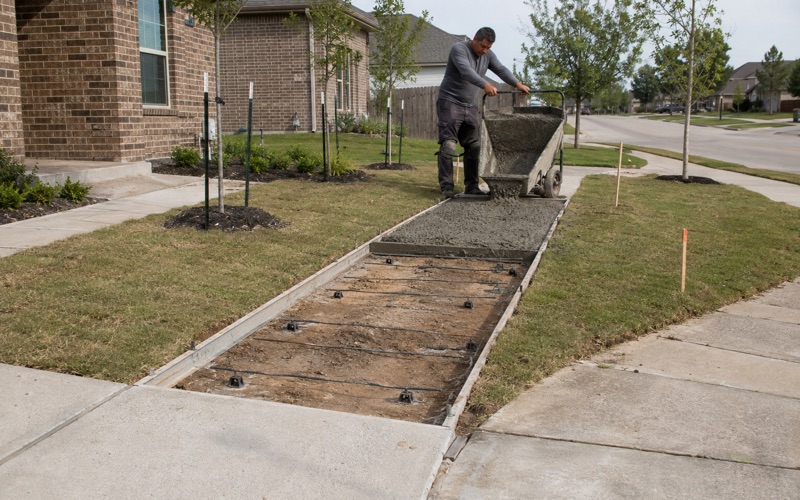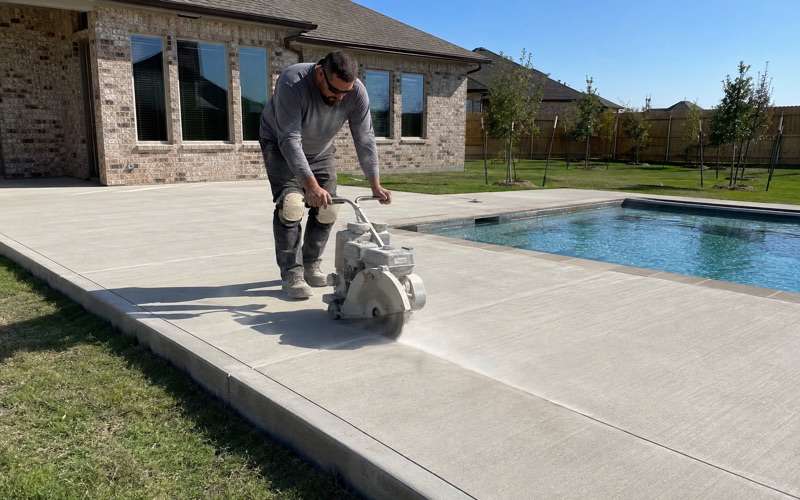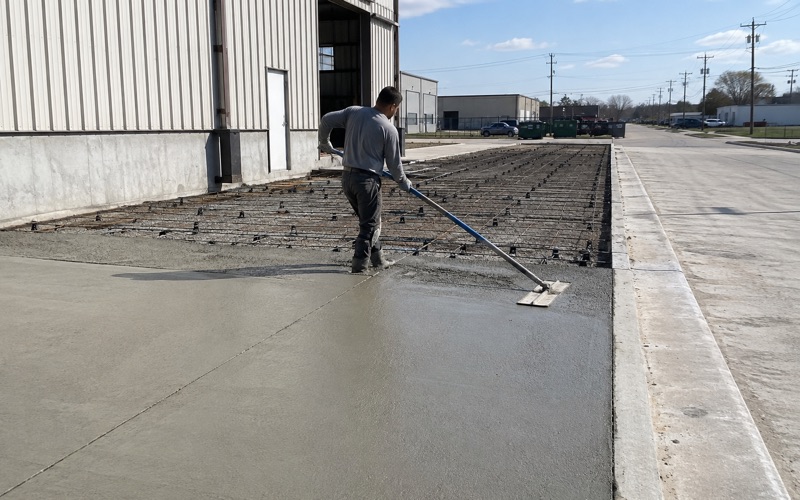
Kyle Elite Concrete works as a concrete contractor in Lost Creek, TX on driveways, walks, patios, steps and slab replacement, and almost every job here is cut-and-fill work on grade rather than a flat pour. That single difference shapes the estimate more than anything about the concrete.
The ground is shallow, rocky and steep. A machine that would dig all afternoon on the flat east of here meets weathered rock inside the first foot and a half across most of this place, and considerably harder rock much sooner than that in one corner of it. What that costs depends on which of the two it hits, and the two are interleaved closely enough that the answer varies within a single lot.
The other thing worth knowing early is that the work here is overwhelmingly replacement rather than new construction. The place is almost completely built out, so the flatwork that is failing has already given decades of service on ground that barely moves. That changes what a diagnosis looks like, because the usual suspect is the slab’s own age and construction rather than anything the soil is doing to it.
Steep, Shallow and Rocky Rather Than Soft
The Dominant Map Unit and What Is Inside It
Point queries across the place put three of five samples in the Brackett-Rock outcrop-Real complex on 8 to 30 percent slopes, which covers the north and the center rather than one corner. That unit is 38 percent Brackett, 25 percent bare rock outcrop, 22 percent Real and 10 percent Eckrant.
A complex like that is not one condition, it is four interleaved at a scale finer than the mapping resolves. Two ends of the same driveway can present different material, which is why we probe in more than one place before committing to an excavation number rather than extrapolating from the first hole.
One Acre in Four Is Rock at the Surface
Twenty-five percent bare rock outcrop is a bidding fact before it is a construction fact. In that map unit a quarter of the ground is stone with no soil profile over it at all, and the rock outcrop component here is indurated lithic bedrock recorded from zero centimeters. There is no topsoil to strip and nothing to compact; there is simply rock where the drawing shows subgrade.
Where a slab can bear directly on sound stone, the support question answers itself and the concrete gets simpler. Where a footing, a trench or a service line has to cross that stone, breaking or sawing becomes the dominant cost on the job, and it is not a line anyone can estimate from a photograph.
Slope as the Working Constraint
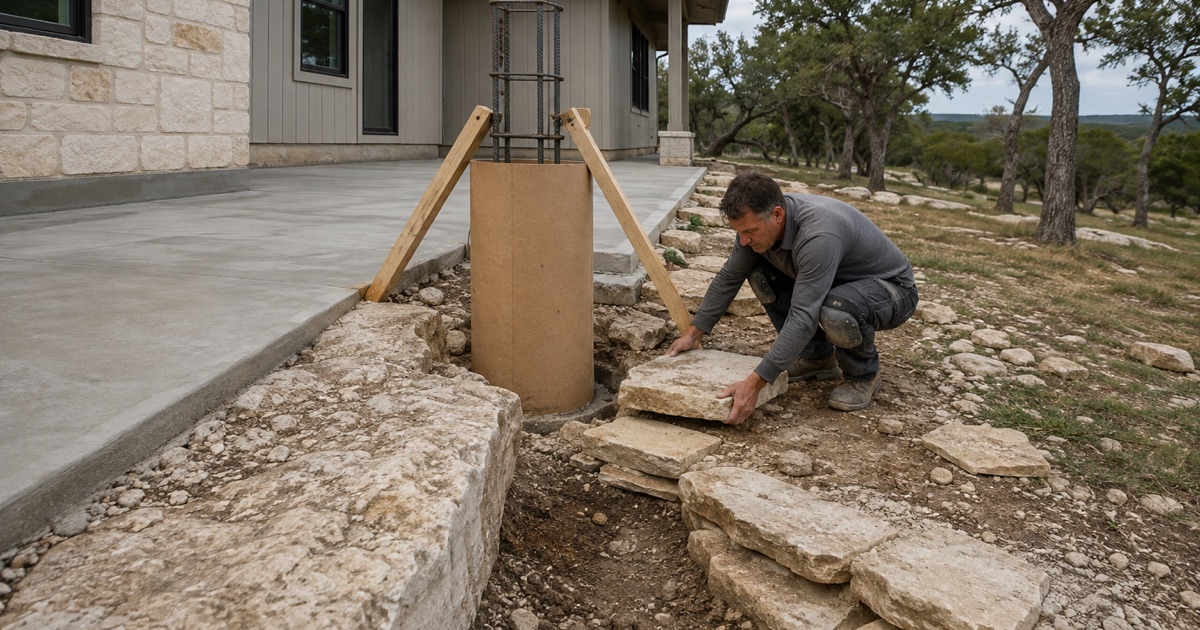
The dominant unit is rated 8 to 30 percent and the Eckrant unit 5 to 18 percent, so patios, walks and drives here are terraced, stepped or retained far more often than they are simply poured. Forming on that gradient takes more staking, more attention to concrete workability and more hands on the pour.
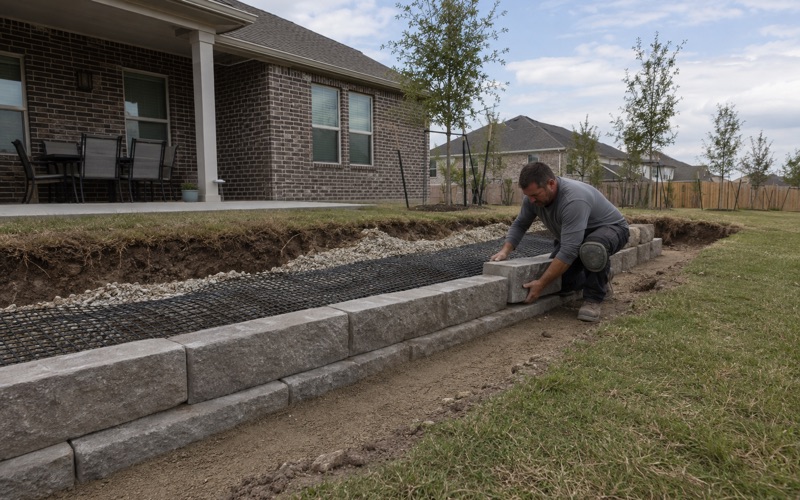
That shape also means a flatwork job here frequently carries a retaining element, and retaining changes the permitting picture in a way a patio on its own does not. We scope the whole thing together rather than pricing a slab and then discovering the wall it needs, because the wall is often the larger half of the work and always the slower half to approve.
Looking for concrete-contractor closer to Bee Cave? See Concrete-Contractor in Bee Cave.
Why the Plasticity Index Is the Wrong Headline
Brackett and Real, Read on Both Numbers
Brackett’s A and Bk horizons carry a representative plasticity index of 17 to 18 at 30 percent clay, and Real carries 14 to 15 at 25 percent clay. Read alone, those figures would place both soils near the threshold at which a soil starts being treated as one that moves seasonally.
The movement measurement says otherwise. Linear extensibility runs only 2.3 to 3.3 percent through Brackett and 0.8 to 1.9 percent through Real, which is very little seasonal movement by any standard you care to apply. The two numbers point in different directions, and only one of them describes what this ground actually does through a wet spring and a dry August.
What the Carbonate Content Explains
The reason sits in the chemistry: both profiles run 55 to 65 percent calcium carbonate. The clay fraction is present, but the mineral content around it means the profile does not swell and shrink the way the plasticity figure alone would imply. This is why we read the two measurements together on every soil report rather than quoting whichever one came first.
For a contractor this is the difference between two quite different designs. Detailing a Lost Creek driveway as though the subgrade will move through a dry summer buys reinforcement the ground will never call on, and does nothing whatever about the constraint that actually governs here. You end up paying for the wrong insurance while the real risk, which is bearing and excavation, goes unpriced.
What It Means for How a Slab Is Detailed
Because the dominant soils barely move, the design effort goes into bearing, drainage and the transition between soil-supported and rock-supported areas rather than into seasonal movement. A slab spanning from rock to soil within a single pour is the situation that produces cracks here, because one end of it is sitting on something that will never settle and the other end is not.
We look for that transition specifically, place joints where the support changes, and set reinforcement to carry the slab across it. That is a different instinct from the one the ground a few miles east teaches, and applying the wrong one is how a technically well-built slab still fails.
Two Refusal Depths and Two Hardnesses
Rippable Weathered Marl at Thirty-Six Centimeters
Brackett carries weakly coherent paralithic bedrock at a representative 36 centimeters, roughly 14 inches, and Real carries the same at 36 centimeters. Both are weathered marl that a toothed bucket or a ripper can work through without bringing in special equipment. Fourteen inches is shallow enough to matter on almost any footing or service trench, and deep enough that a standard slab section still sits in soil rather than on stone.
That is the manageable case and it covers most of the place. Excavation is slower than it would be in soil, but it is predictable, and a trench or footing to normal residential depth becomes a matter of time rather than of specialist plant. Predictable is the word that matters in an estimate, because it is the difference between a firm number and a contingency you pay for either way.
Eckrant, and Indurated Rock at Eight Inches
Eckrant carries indurated lithic bedrock at 20 centimeters, about eight inches, and indurated rock is not rippable. On the east side of the place, where Eckrant very stony clay is mapped on 5 to 18 percent slopes, a trench that ran easily across one lot can stop dead on the next.
Eckrant also reads differently on the soil side, with a representative plasticity index of 34 and a liquid limit of 63 at 50 percent clay, though linear extensibility of 3.1 to 4.4 percent keeps the actual movement modest. It is the one part of the place where both the excavation answer and the soil answer change together.
The Barton Creek Strip, Which Is Neither
The Barton Creek corridor through the place maps as mixed alluvial land on 0 to 1 percent slopes, frequently flooded. It is a single layer running from 0 to 122 centimeters at 90 percent sand and 5 percent clay, with a plasticity index of 2 and linear extensibility of 1.5 percent, which is inert material with effectively no seasonal movement in it at all.
Bearing, drainage and flood exposure in that strip have nothing in common with the uplands three hundred feet away. Flatwork there is a drainage and flood-exposure question first, and the design conversation starts from somewhere else entirely. Sand at 90 percent with almost no clay carries load differently and moves water differently, so neither the excavation assumptions nor the bearing assumptions from the rest of the place transfer into it.
Who Approves the Work, and What the Job Usually Is
No Municipal Permit, and What Gates Flatwork Instead
There is no city of Lost Creek and no municipal building department; the place is unincorporated Travis County sitting inside Austin’s two-mile extraterritorial jurisdiction. Travis County’s published single-family permit list covers homes, additions, driveways, retaining walls, fences, pools and right-of-way work, and it has no category at all for a patio, walkway, porch slab or slab replacement outside the right-of-way.
What actually gates that work is the deed restriction and architectural control document covering your section, and more than a dozen different documents govern different parts of the place. We ask which one applies to your lot at the estimate rather than after a neighbor asks who approved it.
Driveway Approaches and Retaining Walls
An approach onto a maintained county road does require a county driveway permit, must be paved with concrete, and runs 12 feet minimum to 25 feet maximum at the right-of-way line at roughly 90 degrees, with a maximum approach grade of 15 percent. A pre-pour inspection is required before concrete is placed.
A residential retaining wall also requires a county permit, with a site plan showing the walls, their top and bottom elevations, an erosion and sedimentation control plan and all easements and setbacks. Any wall over five feet needs that site plan sealed by a Texas licensed engineer, which on this terrain comes up regularly.
A Replacement Market Rather Than a New-Build One
With a median year built of 1977 and most units predating 1980, the flatwork here is at or past a normal service life. The failure we are usually called to is a forty-five-year-old slab on a stable, rocky subgrade rather than a young slab being moved by the ground.
That changes the diagnosis in a useful direction. Where the subgrade barely moves, a failing slab is usually telling you about its own thickness, its reinforcement, its joint spacing or where water has been running for decades, and every one of those is an answerable question. We would rather establish which of them applies before quoting a replacement, because sometimes the answer is that a section replacement will do.
- 20+ Years in Hays County
- Insured & Permitted
- Free Estimates