
Kyle Elite Concrete takes on commercial concrete in Kyle, TX for owners, general contractors and property managers, with more than 20 years of it behind us, serving surrounding cities including Buda, San Marcos, Manchaca, Shady Hollow, Redwood. Commercial work differs from residential less in the concrete than in everything wrapped around it.
The mix designs are familiar. What changes is that the work sits inside a plan set with standard details, gets tested rather than trusted, has to be phased around a business that is still trading, and frequently needs regulatory approval before a machine moves any dirt.
We price and schedule against those realities rather than treating a commercial job as a large driveway. Most of the cost overruns we are asked to look at on other people’s projects came from the approvals and the phasing rather than from the concrete.
Parking Lots and Pavement Sections
Drive Aisles Against Parking Bays
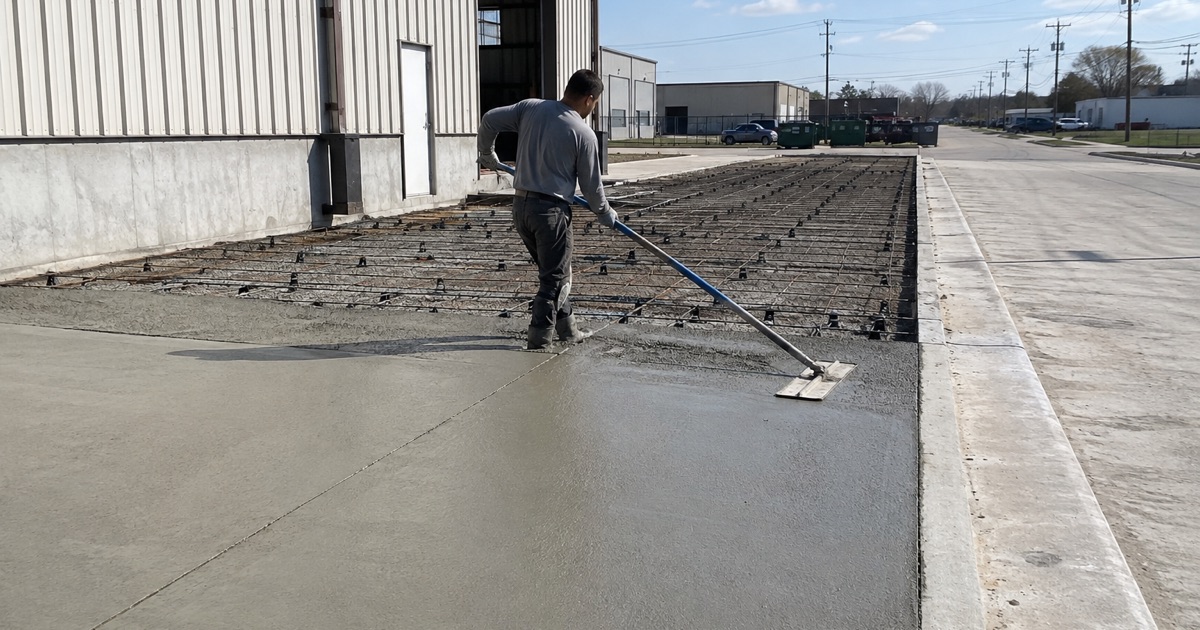
A parking bay holds a stationary car and a drive aisle takes every vehicle that enters the site, including delivery trucks turning under load, and building both to the same section is why lots fail at the entrance while the bays are still sound. We separate the sections, thicken and reinforce the truck paths, and detail the joints to the loading pattern rather than to the square footage.
Dumpster and Container Pads
A container pad takes a concentrated point load from the truck’s rear axle during collection plus the dragging load of the container itself, which is a far harsher duty than the lot around it. Where no local standard detail is published for them, we build to ACI 330 guidance for the actual loading. A pad built as a piece of parking lot is a pad that will be replaced.
Approach Aprons and Turning Radius
The commercial approach carries everything entering the site and is the element most often built to a residential detail by mistake. The plan set has to show the adopted standard detail, including thickness, reinforcing and the turning radius the approach is designed to accommodate. We build the apron that is drawn rather than the one that is quicker to form.
Drainage and Site Grading
Curb and Gutter and Valley Gutters
Curb and gutter, valley gutters and the grades between them are what actually move water off a site, and concrete placed without regard to them creates ponding an owner lives with for twenty years. The flow line has to be continuous and on grade, which makes it a survey question before it is a concrete question. We set the flow line first and pour to it.
Flow Lines, Ponding and Finished Grades
Ponding on a commercial lot is more than an appearance problem: standing water shortens pavement life, becomes an accessibility issue across a route, and in a freeze becomes a hazard. We shoot the finished grades rather than relying on a slope called out generally on a sheet. Where the design will pond, we raise it before construction rather than after the first storm.
Wheel Stops, Bollards and Site Furniture
Wheel stops, bollards, light bases and equipment bases all have to be located and anchored into concrete that was formed with them in mind. Drilling and setting them afterward is possible and always worse. Coordinating those locations before the pour is the sort of detail that separates a lot that looks finished from one that looks retrofitted.
Slabs, Floors and Structures
Commercial Slabs and Warehouse Floors
An interior commercial floor faces rolling loads, racking point loads and often a coating or a polish, which puts flatness, joint layout and vapor control at the center of the specification. A vapor retarder meeting ASTM E1745 under a floor that will be coated is not optional. We build the layers to the specification and record what went in at each stage.
Footings, Grade Beams and Structural Elements
Footings, grade beams, piers and equipment foundations tie into the structural design and are inspected on their own terms. Reinforcing placement, cover and continuity all get verified before a pour rather than described afterward. We work to the engineer’s drawings and provide the documentation the inspection process expects.
Accessible Routes Across a Commercial Site
Every commercial site has accessible routes running across it, and running slope, cross slope, access aisles and curb ramps are all measured against Texas Accessibility Standards with an instrument. A route that reads as flat can still be out of tolerance. We shoot grades before pouring and hand over the achieved numbers rather than leaving them to be discovered at inspection.
Permitting, Phasing and the Aquifer
Working on the Edwards Aquifer Recharge Zone
TCEQ maps place 26.5 percent of Kyle inside the Edwards Aquifer Recharge Zone and 21.4 percent in the Transition Zone, and on the recharge side plan approval under 30 TAC 213 has to be in hand before earthwork rather than during it. A water pollution abatement plan and the impervious cover it accounts for drive the schedule. We confirm the zone at the address and build the approval into the schedule.
Phasing Work on an Operating Site
A retail lot, a restaurant or a warehouse cannot close while its pavement is replaced, so the work gets divided into phases with access, parking counts and delivery routes maintained throughout. Cure times set the phase boundaries rather than the crew’s preference. We plan the sequence with the operator before mobilizing rather than negotiating it each morning.
Specifications, Testing and Delivery Tickets
Commercial concrete is verified rather than assumed, which means delivery tickets checked against the specified mix, slump and air content confirmed on site, and cylinders cast and broken where the specification calls for it. We keep the batch tickets and test records and hand them over with the closeout. It costs little and it settles arguments before they start.
- 20+ Years in Hays County
- Insured & Permitted
- Free Estimates