Kyle Elite Concrete works as a concrete contractor in Buda, TX on driveways, slabs, patios, walks and repair work, and the first thing we do on any Buda job is find out which half of the city your address sits on. That is not a figure of speech. The ground here divides almost in two, and the two halves want different concrete.
Clipped to the Buda city boundary, soil survey data puts Vertisols under 46.3 percent of the city and Mollisols under 37.9 percent. One of those is deep, high-movement clay. The other is largely shallow calcareous ground over limestone, where the problem is not heave but depth to refusal.
A contractor who prices Buda from a single mental picture of the ground will be wrong on roughly half the addresses in town, in one direction or the other. We would rather spend an hour identifying which situation your lot presents than write a number that suits the average of two conditions that do not average.
Why One Buda Address Needs a Different Slab Than the Next
The Ground Splits Nearly in Half
Vertisols at 46.3 percent and Mollisols at 37.9 percent is not a close call rounded into a tie; it is a genuine split, with each order dominating a different part of town. The deep-clay units cluster to the east and the shallow calcareous units toward the western edge, and the boundary between them does not follow any street a driver would notice.
What that means practically is that two jobs a few minutes apart can need different slab thicknesses, different reinforcing layouts and different excavation allowances, for reasons that are invisible from the curb. We treat the soil identification as part of the estimate rather than as a technicality to sort out on the morning of the pour.
Parent Material Tells the Same Story
The parent material split lines up with the soil orders: 42.8 percent of the city’s named soil components formed in mudstone, shale or claystone residuum, and 35.5 percent in limestone, chalk or marl, with a further 7.9 percent in alluvium not attributed to a named rock. Those three origins behave differently under a slab in ways that show up years later.
Residuum from mudstone and claystone gives you the smectite-rich clays that swell and shrink with moisture. Limestone and marl give you thinner profiles with rock underneath. Alluvium gives you variable material that has to be assessed rather than assumed, particularly in the low ground near Onion Creek on the northwest side.
Every Driveway Here Starts With a Permit
Buda’s Unified Development Code puts driveway work inside the permit system in unusually direct language. UDC 3.05.09.B.1 states that a person commits an offense if the person constructs, reconstructs, relocates or in any way alters the design or operation of any driveway without first obtaining a building permit issued by the Building Official.
The city’s own guidance lists foundation repairs, driveways and re-roofing among the common situations requiring a permit, and applications go through the Development Services Department electronically via the MyGovernmentOnline portal. Plan review typically runs 10 to 15 business days, so we build that window into the schedule rather than discovering it after you have cleared your calendar.
Looking for concrete-contractor closer to San Marcos? See Concrete-Contractor Services in San Marcos.
The Deep-Clay East Side
Heiden and Houston Black, Measured
The high-movement half of Buda is genuinely high-movement, and the numbers are not marginal. Heiden clay on 3 to 5 percent slopes covers 14.25 percent of the city with Heiden on gentler slopes adding another 8.17 percent, carrying a representative plasticity index of 40, liquid limit 60 and 50 percent clay with linear extensibility of 12.0 to 12.2 percent through the profile.
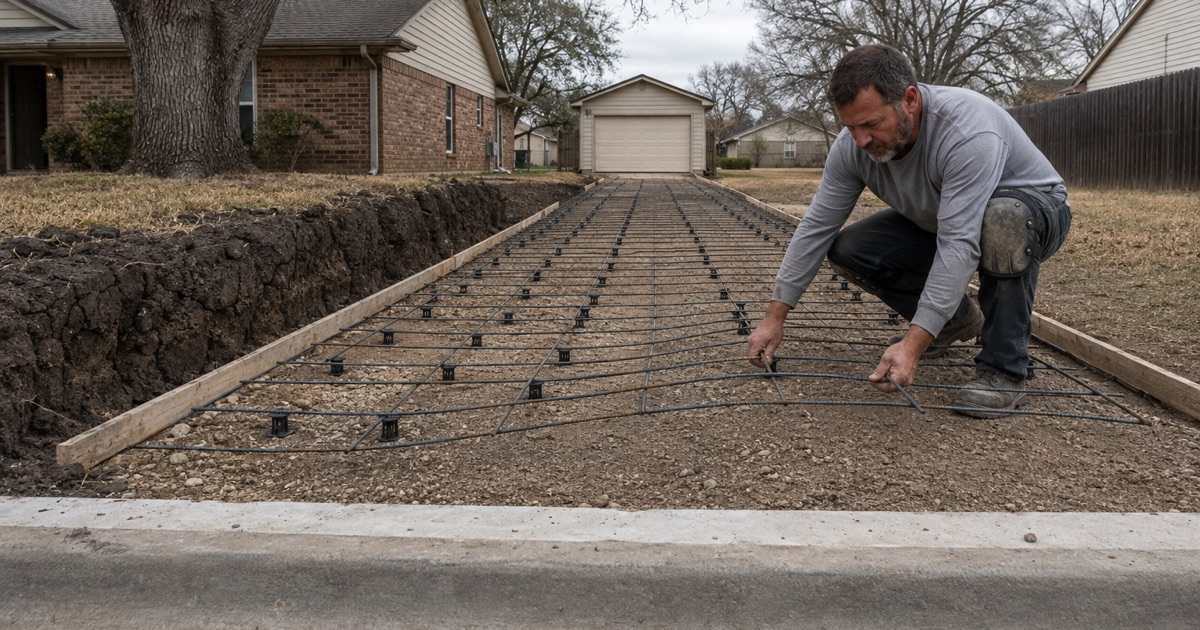
Houston Black clay on 1 to 3 percent slopes covers a further 13.09 percent at plasticity index 44, liquid limit 70, 54 percent clay and 12 percent linear extensibility from the surface down to 178 centimeters. On ground like this the reinforcing is not there to stop movement, which nothing poured on top can do. It is there to keep the slab acting as one piece while the ground moves underneath it.
Branyon and Tinn in the Lower Ground
Branyon clay accounts for 4.78 percent of the city on nearly level ground plus another 1.43 percent on gentle slopes, carrying a plasticity index of 39 at the surface that rises to 43 deeper in the profile with linear extensibility reaching 13 percent. That is the highest shrink-swell figure recorded among the city’s common units.
Tinn clay covers 3.41 percent and is frequently flooded bottomland at plasticity index 41 with linear extensibility of 9.3 to 10 percent. On a Tinn lot the moisture question is not seasonal drying but standing water, which changes both the subgrade preparation and where the concrete can reasonably go at all.
Drainage Under a Slab on Vertisol Ground
Saturated hydraulic conductivity separates the two halves of Buda more sharply than any other single number. The Vertisol units run about 0.21 micrometers per second through the profile, which in practical terms means water arriving under a slab has nowhere to go and stays there, cycling the clay through wet and dry states.
That is why base drainage detailing on the clay side is a design item rather than a formality, and why the same detail used on the limestone side would be a waste of money. Getting water away from the slab edge and out of the base does more for a driveway on Heiden or Houston Black than an extra inch of concrete would.
The Limestone Western Edge
Depth to Refusal, Which Is Not a Constant
On the western side the governing question is how far down the machine gets before it stops. Doss silty clay covers 5.77 percent of the city with weakly coherent paralithic bedrock at about 43 centimeters. The Austin-Castephen complex covers 3.64 percent with paralithic bedrock at 61 centimeters under Austin and 46 centimeters under Castephen, both over Austin chalk.
Rumple-Comfort rubbly association covers 4.5 percent, with indurated limestone at 71 centimeters under Rumple and only 30 centimeters under Comfort, and Real gravelly loam adds 1.71 percent with paralithic bedrock at 36 centimeters. Those depths are close enough to normal excavation depths that they change the price of the hole rather than the design of the slab.
Rock Is a Depth Problem, Not a Surface One
It is worth being precise about what this side of town looks like, because people picture exposed stone. Mapped rock outcrop components total 0.2 percent of the city. You will not generally see the rock; you will meet it about a foot and a half down.
That distinction matters for bidding, because a lot that looks like ordinary yard can still carry a saw-cutting or breaking allowance. We probe before we price on the western side rather than writing an excavation line that assumes clean digging and then revisiting it.
Gruene Clay and a Pan at Thirteen Inches
Gruene clay on 1 to 5 percent slopes covers 4.91 percent of the city and is the one unit where the machine reliably meets hardpan inside the first foot and a half. The Gruene component carries a strongly coherent petrocalcic horizon at a representative 33 centimeters, roughly 13 inches down.
What makes Gruene instructive is that its surface horizon carries a plasticity index of 23 with linear extensibility of only 4.5 percent. The excavation problem and the movement problem are not the same problem, and on a Gruene lot you are buying the first one without much of the second.
Krum Ground, Where the Plasticity Index Overstates the Movement
Plasticity Index 31 to 34 Across 14.3 Percent of the City
The Krum series covers 14.3 percent of Buda between two map units, which makes it the third most extensive soil in town, and it is the one that catches people out. Krum carries a representative plasticity index of 31 to 34 with 45 to 50 percent clay, which reads like a high-movement clay by the number most commonly quoted.
Reporting that figure on its own would put Krum in the same conversation as Houston Black. A bid built on that reading arrives with reinforcing and thickness sized for movement the ground will not actually deliver, which costs you money for nothing.
Linear Extensibility 7.0 to 10.3 Percent, and Why
The shrink-swell measurement tells the other half of the story. Krum’s linear extensibility is 7.0 to 10.3 percent, well below the 12 percent recorded for Heiden and Houston Black, and the reason sits in the same profile: 8 to 35 percent calcium carbonate through the soil, formed as it is in calcareous silty and clayey alluvium derived from limestone.
Carbonate suppresses the shrink-swell behavior the clay fraction would otherwise produce. Both numbers, the high plasticity index and the moderate linear extensibility, come from the same profile description, and reading one without the other is how a Krum lot gets priced as something it is not.
Bidding Krum Without Overbuilding or Underbuilding
In practice this means Krum ground gets its own treatment rather than being folded in with the Vertisols beside it. It is not benign, and we do not build it like the shallow calcareous units either, since 45 to 50 percent clay is still clay and saturated hydraulic conductivity of 0.9 to 1.2 micrometers per second is still slow drainage.
What it means is a slab detailed for real but moderate movement, at a cost that reflects the measured behavior rather than the alarming half of the data. Naming which series is under your lot, and quoting both numbers for it, is the part of a Buda estimate that is worth more to you than the price per square foot at the bottom.
- 20+ Years in Hays County
- Insured & Permitted
- Free Estimates