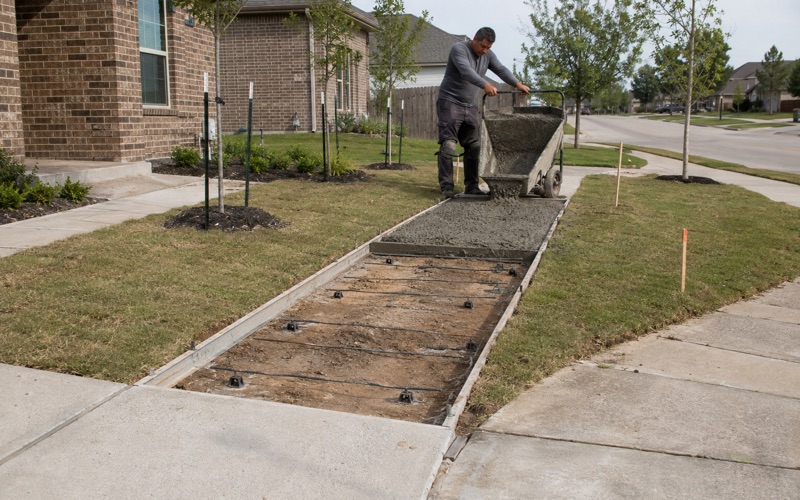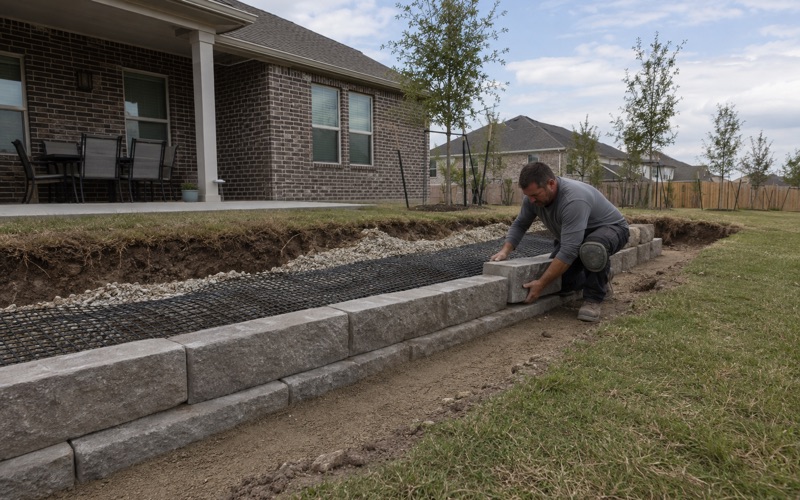
Kyle Elite Concrete works as a concrete contractor in Barton Creek, and after more than twenty years of placing flatwork we open every job the same way, by finding out what is underneath it first. Driveways and approach aprons, patios and pool decks, walks, garage and shop slabs, and repair on concrete that has reached the end of its first life.
That habit earns its keep here more than in most of the places we work. A driveway bid is really two bids stacked on each other, one for the ground and one for the concrete, and only the second half of that stays the same from one address to the next.
So we walk the lot before we price it, read what the soil survey publishes for that particular point rather than for the general area, and set excavation, base and reinforcement from what comes back. The mix and the finish follow the ground. They do not lead it.
One place, two grounds, and the line between them
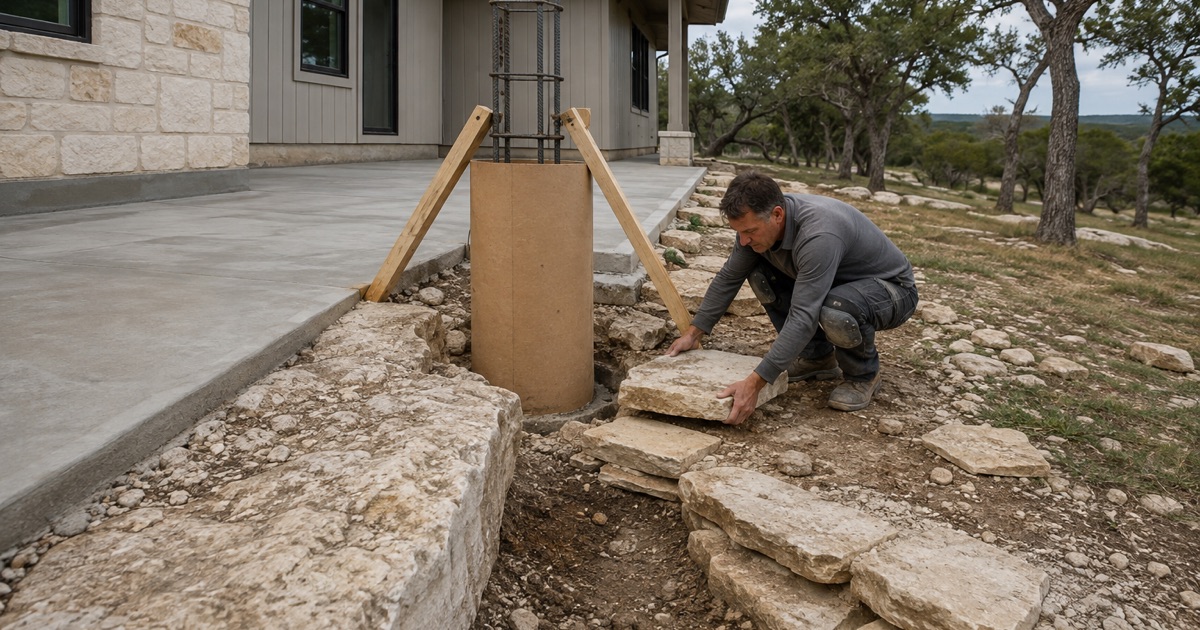
Barton Creek does not hold a single profile from one side of itself to the other. Point queries into the Travis County soil survey, clipped to the boundary of the place, return four different map units, and the two that carry most of the housing sit at opposite ends of everything that matters to a slab.
The center: one acre in five is bare rock
The map unit under the middle of Barton Creek is a Brackett and rock outcrop complex on 1 to 12 percent slopes. Its composition is 68 percent Brackett with 20 percent bare rock outcrop, and San Saba and Volente make up 4 percent each. One acre in five in that unit is rock at the surface with no soil over it.
That changes the shape of the work before a single yard of ready mix is ordered. There is often nowhere to cut down to reach the elevation a plan asks for, so the finished grade has to be built up in flexible base instead, and the base thickness under the slab becomes a material line item rather than a grading one.
Refusal at about 18 inches, and what kind of rock it is
Brackett here carries weakly coherent paralithic bedrock at a representative 46 centimeters, roughly 18 inches, in the 1 to 12 percent unit, and shallower at 36 centimeters in the 8 to 30 percent unit on the east side. That contact is what a trenching bucket finds when a turndown edge or a grade beam has to go deeper than the slab.
The useful part is the word weakly. This is weathered, rippable marl rather than hard limestone, so hitting it is a grading cost and an hour on the machine, not a rock breaker mobilized to the site. We would rather tell you that at the estimate than discover it with a crew standing around.
The creek corridor, which is neither one
Two of our sample points, both along the creek itself, come back as mixed alluvial land on 0 to 1 percent slopes, frequently flooded. It reads as a single layer from 0 to 122 centimeters at 90 percent sand and 5 percent clay, with a plasticity index of 2 and almost no shrink and swell in it at all.
Sand that clean compacts predictably and drains beautifully, which is why it is tempting. It is also a flood exposed strip rather than a building subgrade, and we treat anything we build in it as replaceable surfacing with generous isolation joints, not as a slab we expect to outlive us.
Looking for concrete-contractor closer to Lost Creek? See Lost Creek Concrete-Contractor.
The west side, where nothing stops the shovel
Move west inside the same boundary and the survey returns Volente silty clay loam on 1 to 8 percent slopes, at 75 percent Volente with 15 percent Lewisville and only 5 percent Brackett. Everything the middle of the place teaches a contractor about excavation is wrong on this side of the line.
150 centimeters with no recorded refusal
Volente publishes no bedrock restriction at all. Its horizon sequence runs from the surface to 56 centimeters, then to 91, then to 117, then to 150 centimeters, and the record simply stops there without a contact. More than four feet of soil, and nothing in it that a bucket will refuse against.
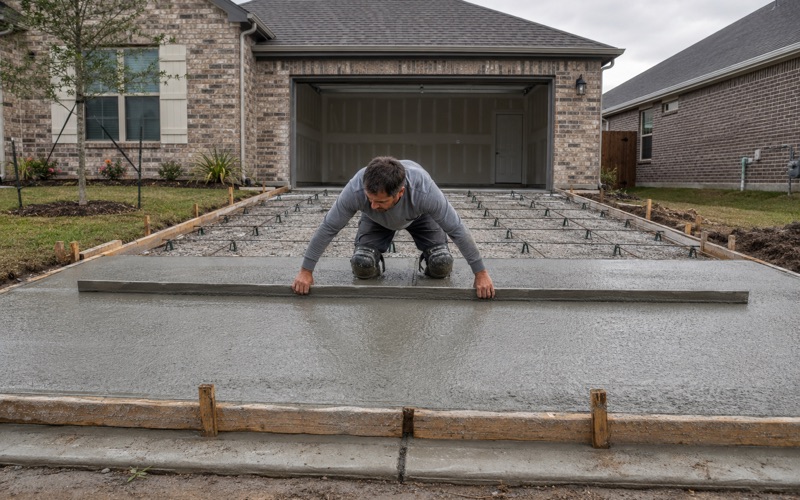
Depth like that is not free. Where the middle of Barton Creek gives us a hard floor to build off, the west side gives us a subgrade that has to be earned, which means moisture conditioning, compaction tested against proctor density, and a base course placed in lifts instead of one thick layer dumped and rolled once.
The deep soil is also the one that moves
Volente carries a representative plasticity index of 24 at the surface, 29 through the middle horizons and 26 at depth, at 36 to 43 percent clay, with linear extensibility between 4.3 and 5.6 percent. Brackett, by contrast, reads 17 to 18 at 30 percent clay and moves 2.3 to 3.3 percent.
The reason is in the chemistry rather than the texture. Those Brackett profiles run 60 to 65 percent calcium carbonate against 3 to 8 percent in Volente, and the residential code treats anything from a plasticity index of 15 upward as expansive, so both of these clear that bar while behaving nothing alike underfoot.
Which is why the joint plan is not portable
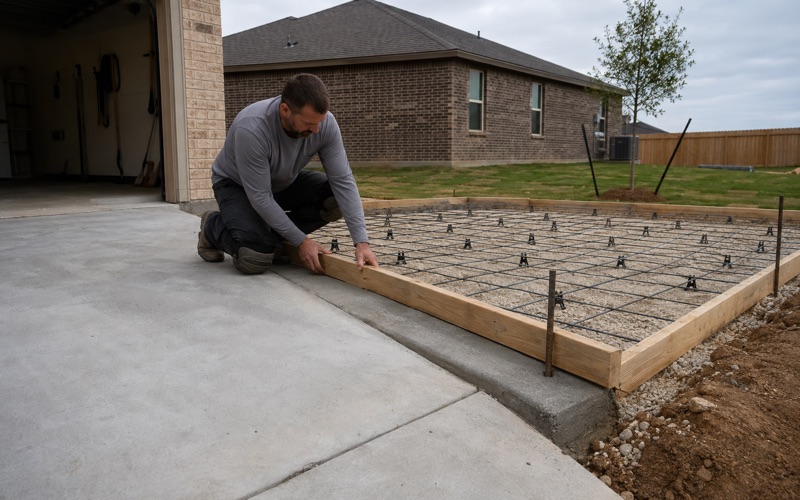
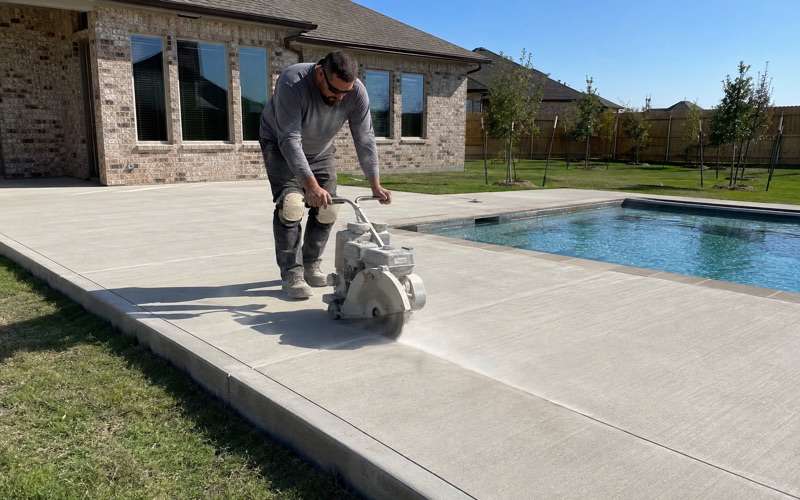
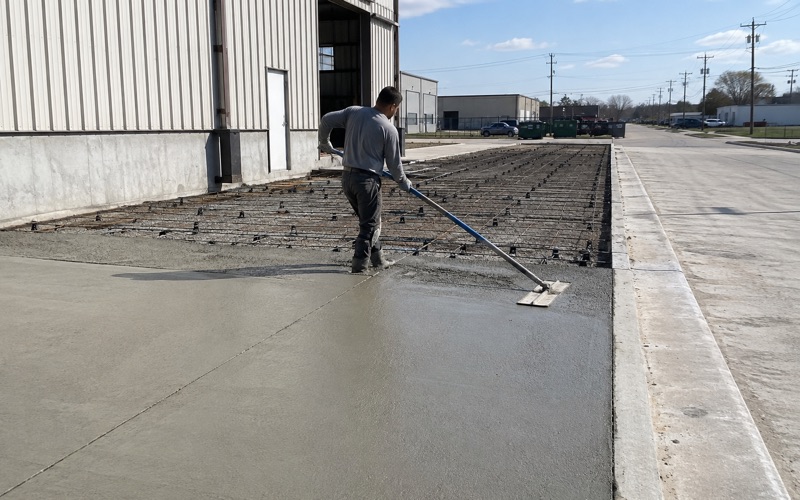
On the west side we tighten control joint spacing, keep number four rebar at mid-depth on proper chairs, and put isolation joints anywhere the slab meets a column, a stoop or a foundation that is going to move on its own schedule. Sawcut joints go in early, while the concrete still cooperates.
Three substitutions we will not make on either side of the place: welded wire fabric in place of the bar, fibrous concrete in place of the bar, and broken brick or rock used as chairs. Mesh ends up on the subgrade under a boot, and fiber controls plastic shrinkage cracking, not slab movement.
Two bids for what looks like one neighborhood
Two lots of the same size, the same design and the same finish, a few minutes apart inside this place, do not come back at the same number. The difference is almost never in the concrete. It is in the four or five ground line items sitting above it on the estimate.
What the shallow side costs
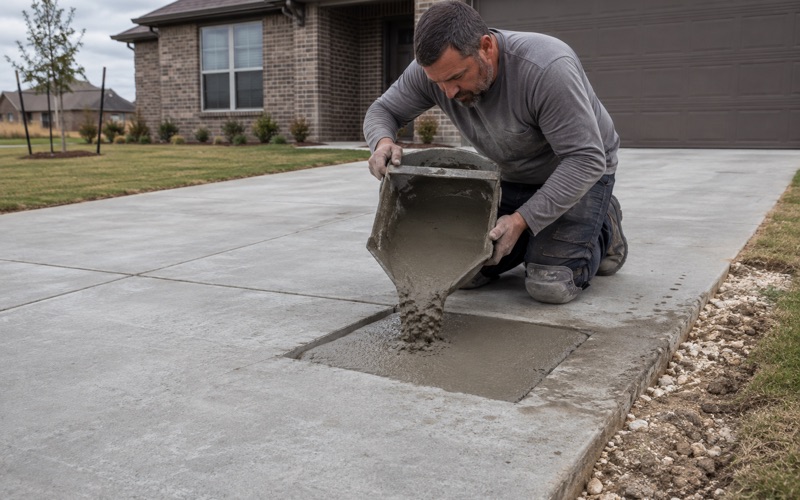
On the rock side, the money moves toward tear out, haul off and imported material. Saw cutting and removal of the old slab is heavier work when there is nothing soft under it, and a driveway that has to sit at a set elevation gets there on compacted base rather than on excavation.
What we save there we put back into the mix and the cure. Class A ready mix at a minimum of 3,000 psi compressive strength is the floor for residential flatwork, we go to 4,000 psi where a drive takes delivery trucks, and hot weather placing gets an evaporation retarder and a curing compound rather than a hose and hope.
What the deep side costs
On Volente the money moves the other way, toward preparing something that will hold still. That means the compaction work above, a thickened edge where the slab carries load, a vapor retarder under anything that will be conditioned space, and a slab designed and sealed by a Texas licensed engineer where the structure calls for one.
We would rather build to an engineered foundation design than around one. On soil that moves this much, a sealed design is the cheapest part of the job, and it is the only thing that makes a claim about performance mean anything years after the truck has left the driveway.
Mid-life concrete, and what it actually needs
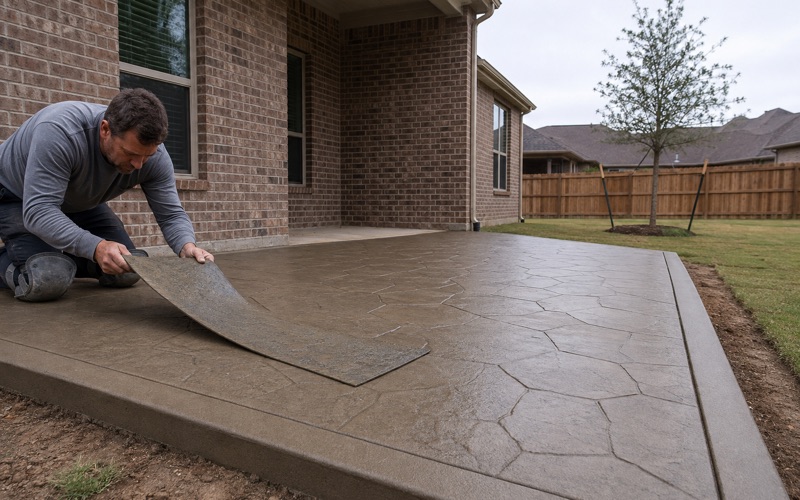
The housing here is neither old nor new. The median structure year is 2005, with 681 units built in the 2000s and 410 in the 1990s, which puts a great deal of the flatwork in Barton Creek at the age where joints have opened, sealers have worn through and decorative surfaces look tired without being structurally finished.
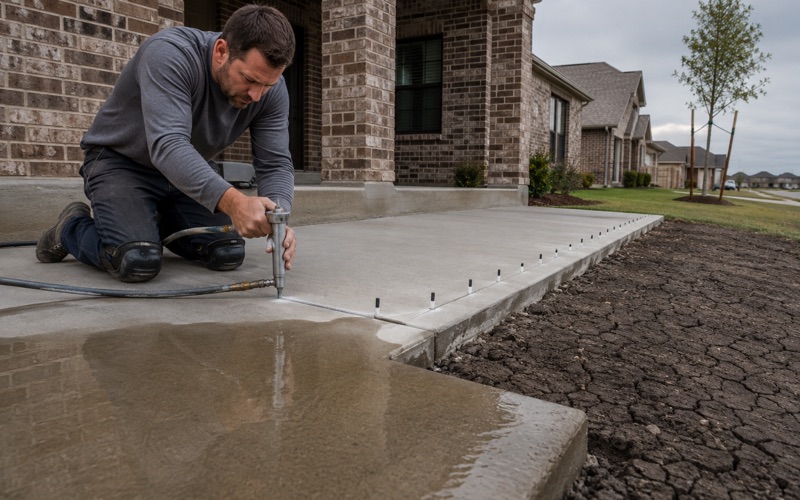
That is often a repair conversation rather than a replacement one. Crack chasing and partial depth repair, polyurethane foam injection where a slab has voided and settled, a resurfacing or a microtopping over sound concrete, and a penetrating sealer instead of the film forming product that made the patio slick the first time.
Who signs off here, and the cover limit that shapes the job
There is no city of Barton Creek. Every point in the place falls in unincorporated Travis County inside the City of Austin two mile extraterritorial jurisdiction, which is an arrangement where Austin regulates water quality and subdivision and very little else. One Austin case file for a site in this watershed records the council district as not applicable.
Impervious cover is the constraint that shapes what gets built
The whole place sits in the Barton Creek watershed, the Barton Springs Zone and the Edwards Aquifer contributing zone. Austin’s Save Our Springs rules allow 20 percent of net site area here, against 15 percent in the recharge zone and 25 percent in the other contributing zone creeks, and net site area counts only the uplands.
There is no way around that number. Land Development Code Section 25-8-515 prohibits variances from the ordinance outright, so the only real relief is a site specific amendment or the redevelopment exception written for existing commercial property. We size a patio against whatever allowance the lot has left before we draw it, not after.
Driveways, private streets and the pre-pour call
An approach onto a maintained Travis County road takes a county driveway permit and has to be paved in concrete, 12 feet minimum and 25 feet maximum at the property line, roughly square to the road, at no more than a 15 percent approach grade and no more than 2 percent where a sidewalk crosses.
Plenty of drives here are not in public right of way at all, because the club and resort streets are private and the county issues no permit for a connection to an unaccepted road. Where a permit does apply, the pre-pour inspection happens before the truck arrives. Missing it invites a notice to remove and replace.
New construction, aquifer review and the things nobody permits
New building over the contributing zone needs an Edwards Aquifer protection plan approved by the TCEQ under 30 TAC Chapter 213 first, with up to 30 days of administrative review and 90 days of technical review. That is a calendar item, and we would rather it appear on a schedule early than surprise a start date.
New houses also get a foundation stage inspection before concrete is placed under the county’s residential construction standards, contracted by the builder. A patio or a walk outside the right of way, by contrast, has no permit category at all here, so the controls that bind are the cover allowance and whatever the club or subdivision architectural committee requires.
- 20+ Years in Hays County
- Insured & Permitted
- Free Estimates